Beyond the ordinary
Herbalism
Herbalism in the Northwest
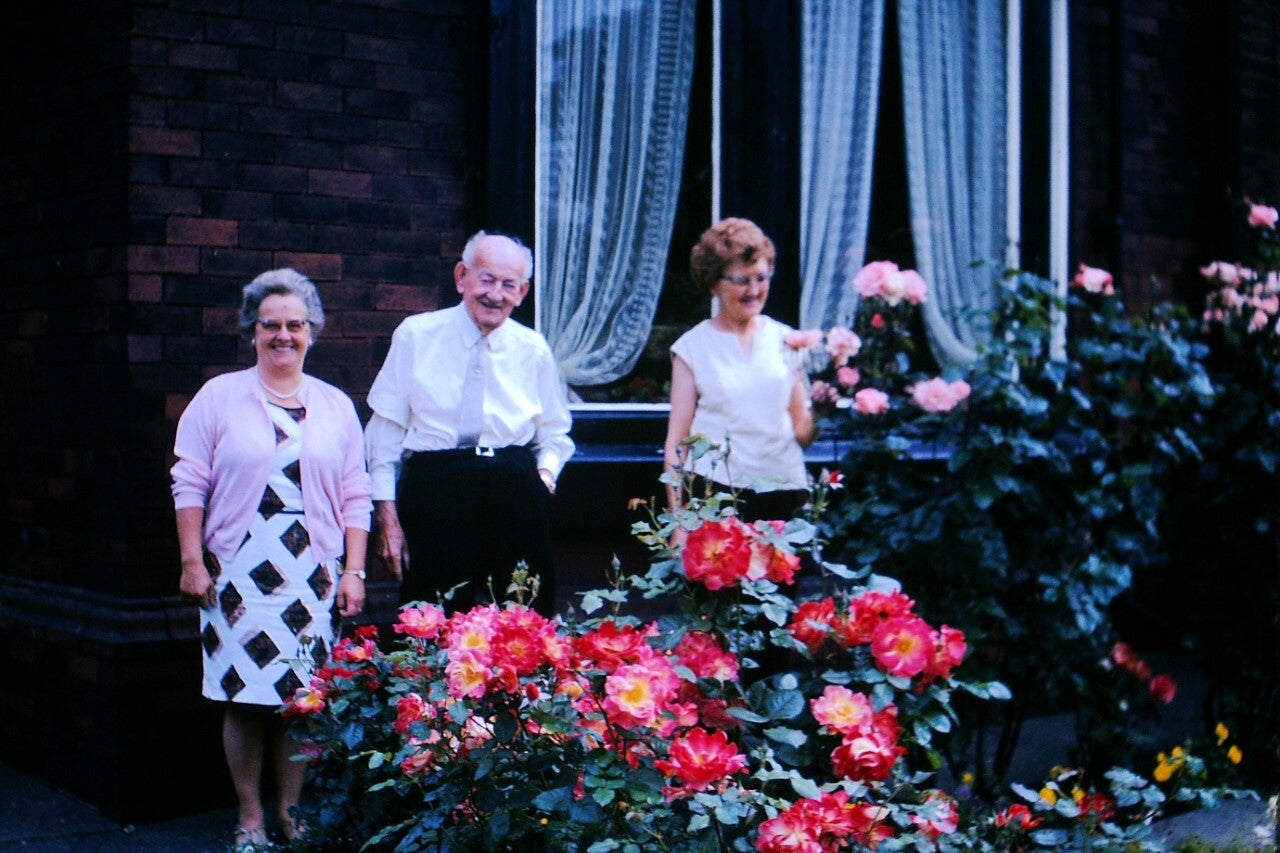
John & Esther Unsworth were herbalists in the town of Bolton, This has been brought together with memories from my dear mother & father – Kath & David as there was no definitive history of them both and the work they did and the legacy that then grew.
As a small child I remember being taken by my parents and grandparents to see Esther Unsworth who at that point was living at Piggott Street, Bolton. I loved the herbal wine and would always try and sneak more than was given!
The first part is from my mother’s memories..
“I think he was born about 1893, he is listed as a Physio-Medical Practitioner in the British Phone Book 1940 edition, living at 65 Bolton Road, Farnworth.”
“Just before he died in Oct 1973 he and Esther moved into a bungalow at 172 Piggott Street, Farnworth. He told me some of his back-story when he was a child. Apparently he was diagnosed with tb of the stomach and bowels, and suffered much pain and discomfort as a teenager. His parents even took him to Harley Street, where he was told it was doubtful if he would make it to his 21st birthday.”
“One Sunday, his parents had gathered up the family to attend church, but John was in pain and refused to go. He went for a walk in the nearby woods, sat on a fallen tree trunk and contemplated suicide rather than endure unremitting suffering. Along came a tramp-or gentleman of the road, as John expressed it. He remarked that John appeared to be in pain, pointed to some wild plants growing nearby, told him to take them home, boil them up and drink the juice.”
“John took them home, but on informing his mother about his conversation with the tramp, she threw them on the fire. Nothing daunted, John returned to the wood, picked the plants and did as he had been instructed. The pain subsided, but it always returned. John reasoned there was something more to this cycle of pain, and being a nature lover, observed that birds and animals did not appear to suffer most of the diseases that afflicted man. He then decided that diet played a large part in combating disease, and that foods such as vegetables, berries, nuts etc served the body best when eaten in their natural state.”
“He went on to make a study of anatomy and physiology, and discovered that eating meat such as beef, steak, pork, bacon, ham, pork sausages, liver, kidneys and veal were detrimental, as animal blood was ingested together with the meat, because human and animal blood are incompatible. Over time, this affected the body in later life. He also found out that all meat from a pig was particularly harmful, as pigs are full of internal parasites.”
“He served in the First World War in the medical corps, then became a full time herbal practitioner afterwards. His reputation was such that doctors used to consult him on the sly. He also said that the neck was very important, as the nerves from the brain all came down there through the spinal column, (similar to the a tree with its trunk and roots) and is there was a problem with the neck, this could affect the nervous system running through the body. For example, a trapped nerve in the back causes sciatica.”
“John also obtained a device which he referred to as a ‘black box’ form the USA. This enabled him to discover exactly what was wrong with the patient, and which concoction of herbs would cure the condition. Apparently there were only two of these devices in the UK, and he owned one of them. When you went to John as a patient, he would use a small spring-loaded device to take a spot of blood from the earlobe. This was smeared onto a plain white paper disc, and the tests would be done from that.”
“Normally the patient would receive two small bottles of herbal medicine, which were dispensed by dropper, and told to take 4-6 drops three or four times a day for 1 month. The medicine was changed each month until the condition cleared. A diet sheet was also given, with any forbidden food crossed out in red. The patient was expected to adhere to that died for the remainder of their lives. This diet sheet varied from patient to patient.”
“Some of my forbidden foods were things I never ate anyway, all red meat, anything from a pig was crossed off, cigarettes, alcohol, duck eggs, strawberries, gooseberries, rhubarb, all of which were very acidic, globe artichokes. Chicken and turkey were ok provided they were free-range, fish and lamb (I don’t like lamb). Also milk, cream and milk-stout were crossed off my list. He advised brown bread, brown sugar, vegetables, fruits, nuts and seeds. I lost a stone in weight after going to him, not because I was dieting, but according to him my body was getting rid of all the rubbish I had eaten over the years.”
“John Unsworth married at sometime, can’t find the exact marriage as never knew his first wife’s name. He had two children, Eunice and John. His son was killed in WW2 when a ship’s boiler exploded and he was scalded to death. John fell out with his daughter, as Esther told me she refused to stick to the diet imposed by her father, and he cut her off, never mentioning her name again. He had a very short fuse to his temper, and you really had to be careful what you said to him. At some time he formed a partnership with a man named Charlie Abbott, from Leigh, who was also a herbalist. They had a falling-out, and went their separate ways.”
“He married Esther Pomfret in 1964, and they went to Paris for their honeymoon. Esther told me that they visited a show at the Moulin Rouge, and Esther considered it to be extremely boring, and occupied herself by counting the spots on the backs of the chorus girls! Esther was originally one of John’s patients, then became his live-in housekeeper, whom he eventually married. Both were probably in their 60’s by then. They lived in a stone-built Victorian house, No 65 Bolton Road, Farnworth, which was tall and narrow, with three floors. Downstairs was the reception room, complete with polished Victorian furniture, potted palms and oil pictures in heavy gilt frames.”
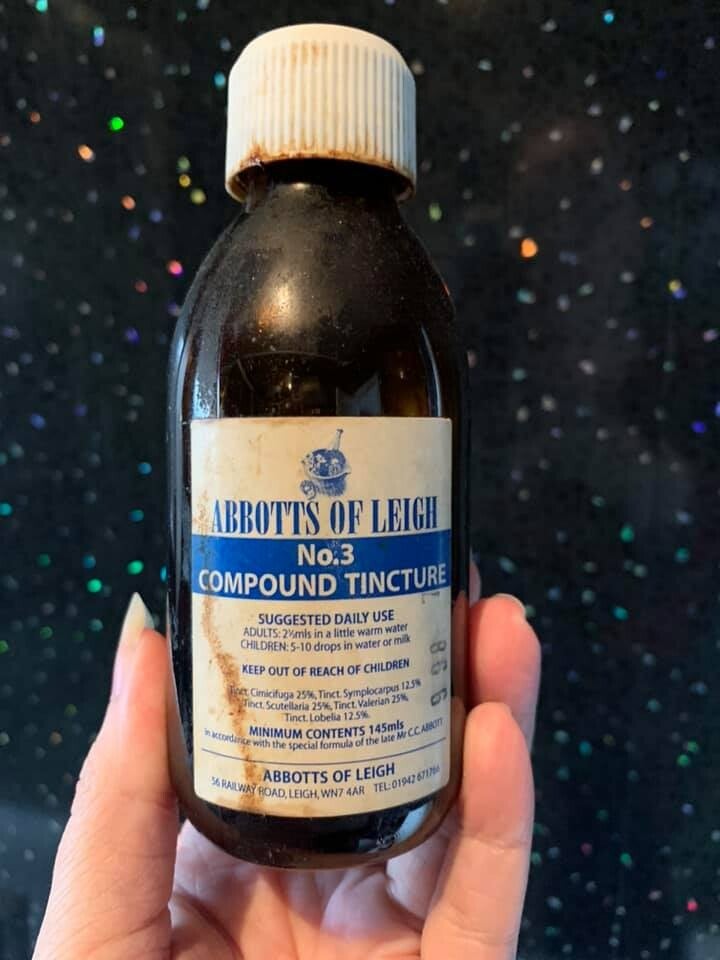
“Down the hall was John’s consulting room, which also doubled as a shop. He sold health foods, herbal wine, compound tincture no 3, chest & lung mixture, flu mixture etc. The house was redolent with the smell of herbs as you entered the hall. Beyond that was the kitchen where Esther made marvellous cakes, usually fresh on the day as you arrived.”
“One day at Bolton Road we were privileged to see the famous machine, or black box. It was situated in one of the upstairs bedrooms, which was unfurnished apart from cabinet containing herbs. There was a huge metal cage, know as a Faraday Cage, which acted as a shield. Dad said that was unnecessary. Inside the cage was a chair, and the sitter acted as the subject, which was always Esther. The sitter had to be in reasonable good health themselves in order to obtain a decent reading. The sitter held a terminal in both hands, and the operator passed a glass rod over the body. Where the rod stuck and refused to move, that was where the problem was situated. Attached to the contraption were two small round white porcelain dishes, and a mixture of herbs and plants were placed in this dish to clear the condition, and the glass rod would not move until the correct proportions and ingredients were added.”
“Apparently the theory behind all this was that John maintained that the body vibrates at differing rates, and if any part of the body was out of synch, this resulted in illness. It wasn’t until many years later that the penny dropped with me, when I heard someone discussing ‘auras’ whereby the body vibrates differing colours of energy patterns. It all sounds totally bizarre, like something out of a bad ‘B’ science fiction movie, but it’s all true, and what is more, it worked!
“After they moved to the bungalow on Piggott Street, John died in October of 1973. Esther continued selling some of the tinctures and herbal wine to a select few of their previous clients. She died some seven years later by sliding off the satin eiderdown on her bed and breaking her leg. I think her sister Audrey found her.”
“At some time Charlie Abbott dies, leaving a widow, he was one his third wife Nellie by then, apparently he was half French and very charming to the ladies. Nellie carried on in Leigh as ‘Abbott’s Herbalists’ and we consulted her when Dad was ill. To her credit she knew what she was doing and fixed him up. This was when he was at the height of his second nervous breakdown. To improve his condition she got a large plaster, smeared it with a herbal mixture, warmed it, and slapped it on the small of his back, which he had to wear it for several days.
“There were also some pills and medicine (slippery elm food) included in the cure. Incredibly, he began to feel the benefit of this plaster compress almost immediately, and as it was almost bonfire night, he felt so much recovered that you and he made a small bonfire and set off some fireworks.”
“After Nellie Abbott died, a Dutchman called Jan de Vries bought out the practice. This man was also a herbalist, and appeared on morning tv for quite some time promoting herbal cures. Many of the herbal cures and medicines filtered down from John Unsworth and Charlie and Nellie Abbott were discontinued, and I think he had more than one shop. Selling his own products.”
Eager to know more I thought to try my luck with social media and joined the facebook group "Kearsley & Farnworth memories" , I was not disappointed with such help from the ladies and gents who were local and members helping with locations and even photo’s of the houses.
‘John R’ had the following to pass on, “I used to work for a physio medical herbalist by the name of Charles Clement Abbot of 56 Railway Rd in Leigh. We used to manufacture a range of herbal products. Mrs Esther Unsworth would order items from us and I delivered them to the bungalow in the photograph. This was at a time after Mr Unsworth death. I used to manufacture Abbot's products from October 1978 to October 1989, Nellie Abbot was my great aunt. My mother's aunt.”
“Charles Abbot lived in a large house opposite St Mary's in Astley. The Lingards. The bungalow next to it was built by him and Nellie to live in (and where he died) but they retained the barn attached to the Lingards. It was used to store herbs and contained a large agricultural grinding machine that produced the mixed dry herbs and also the mix for 'brewing' Vitavin. One of the ingredients in Vitavin was Sea Holly (Eryngium Campestre). This couldn't be bought in, so once a year we would go to Walney Island, Barrow in Furness to collect it from the sand dunes. It was then laid out on chicken wire slung between beams in the barn to dry before being ground up with other herbs to make the Vitavin mixture, the barn was eventually demolished and a number of houses were built on land that goes down to the East Lancs. The access road to these properties is called Abbot's Green.”
Mandy and Andy D had the following information to pass on, “We are the current owners of 172 and have been here for 21 years, my mother in law was here before us from late 90’s, Believe it or not we still receive cassette tapes for Esther from the hard of hearing society. My mother, Doris, was a good friend of Esther, and I remember as a child visiting her on my way to visit my grandmother at 169 Piggott Street. We’ve lived here since 2001.”
Gill T, “I lived at 144 Piggott Street as a child and I believe my mum and dad, Vida and Frank Round lived there from 1970. I was only 4 years old but lived there for over 20 years. My mum was a home help and I remember that Esther Unsworth was one of my mum’s clients. They became very good friends and even after she retired, they remained friends and I vaguely remember visiting her house regularly. Unfortunately, my mum passed away 15 years ago, so I am unable to get you any information but I remember her being a lovely lady and my mum and Esther remaining firm friends for many years.”
Speaking again to my mother I asked how herbalism had helped the family, and she had the following to say. “You had just been born and John’s health was beginning to decline, so they reached out and asked would we as a family like to continue the herbal tradition.”
“We all sat down as a family and discussed the pro’s and cons of the situation and how the ‘health and herbal’ market would fare in Blackpool. John Unsworth thought Dad would make a good successor to the business, but we had a mortgage, and a baby (you) and neither did we want to move to Farnworth. We needed a steady income, and being a herbalist would not guarantee this.”
Looking back I wonder how our family would have taken on this challenge as now the health and herbal market is worth millions.
© JWGregson 2026
Richard 'Lorde' Payne - Hypnotist
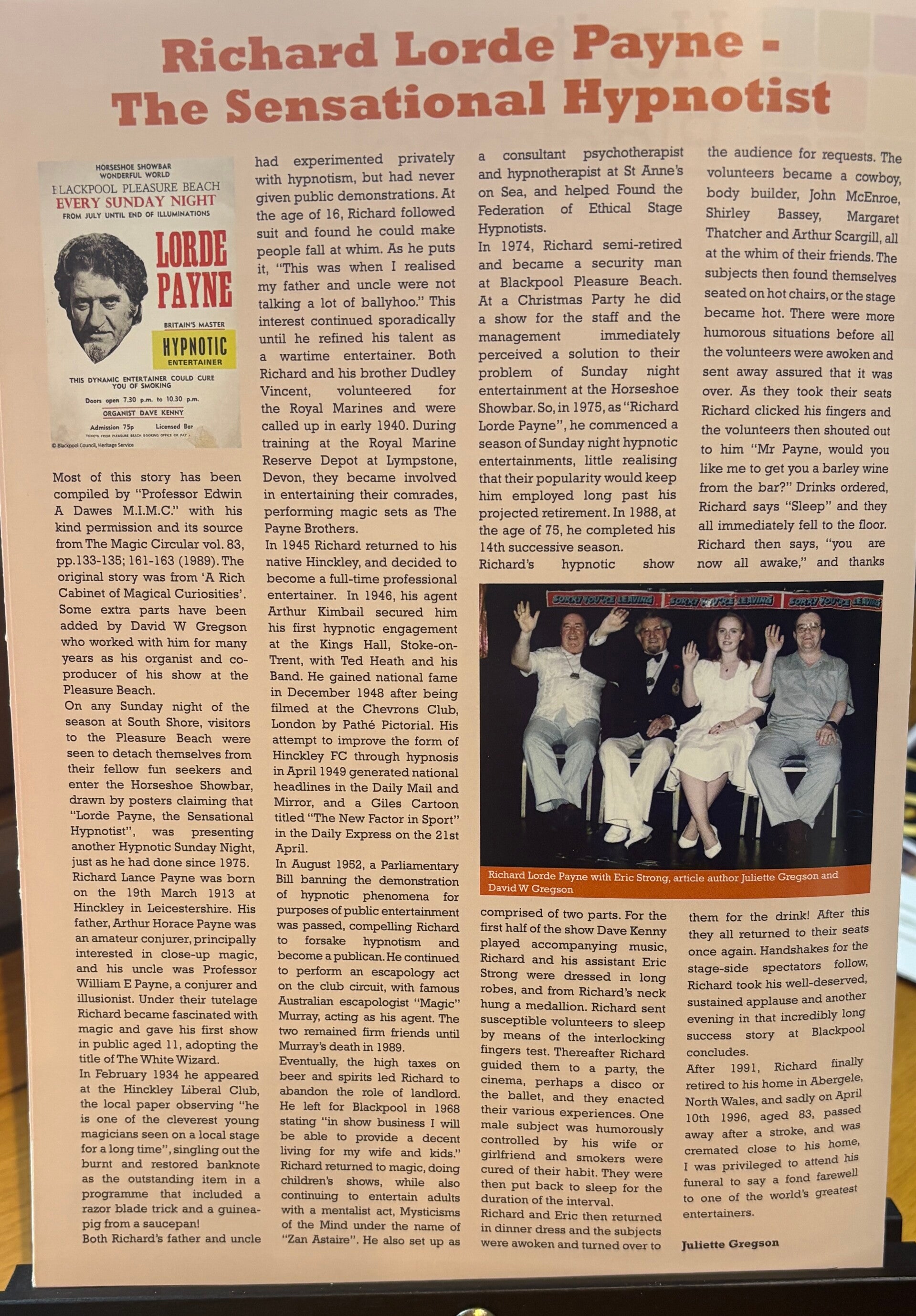
Most of this story has been compiled by “Professor Edwin A Dawes M.I.M.C.” with his kind permission and its source from The Magic Circular Vol. 83, pp.133-135; 161-163 (1989). The Original story was from A Rich Cabinet of Magical Curiosities. Some extra parts have been added by myself after having worked with him for many years as his organist and co-producer of his show at the Pleasure Beach.
My sincere thanks to him for letting me reproduce Richard’s amazing story ! ( David W Gregson © 2017 )
Professor Edwin Alfred Dawes
(6 July 1925 – 3 March 2023 aged 97) was a British biochemist and magician from Yorkshire. As a biochemist, he authored two textbooks and was the long-term and founding head of the Biochemistry department at the University of Hull, where he led its research into bioplastics. As a magician, he was an internationally recognised authority on the history of magic.
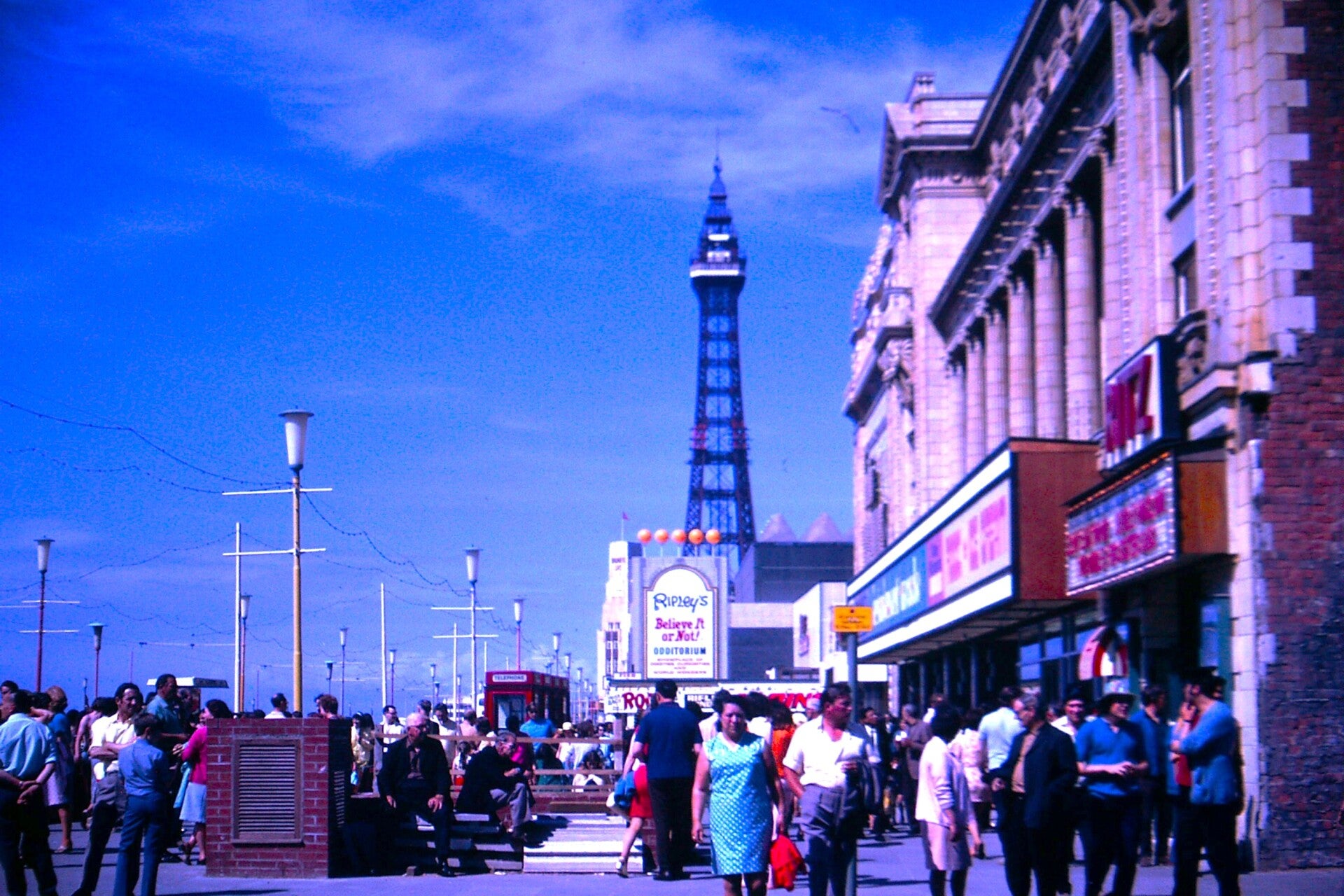
On any Sunday night of the season at the South Shore, Blackpool, some of the crowds at the Pleasure Beach may be seen to detach themselves from their fellow fun seekers who are sampling the Noah’s Ark or the Big dipper and to enter the Horseshoe Showbar. They are drawn irresistibly by posters claiming that Lorde Payne, the Sensational Hypnotist, is presenting another Hypnotic Sunday Night, just as he has done since 1975. Such popularity is impressive and his audiences come from far afield, including Denmark. For many seasons now, one of Lorde Payne’s most ardent supporters has been Peter Börsch of Hilleröd , who makes a traditional pilgrimage to Blackpool each year after attending the British Ring Convention in order to see the Payne Show and to attend the Blackpool Tower Circus.
Peter’s enthusiasm, and his insistence that the author of A Rich Cabinet (Prof Edwin Dawes), must not only experience the Lorde Payne Show for himself but should also record for posterity the interesting life story of its presenter, finally led that chronicler to the Horseshoe Showbar on a Sunday night to meet the veteran showman who celebrated his 75th Birthday in 1988. With the help of the Payne Scrapbook and reminiscences of its owner, the biography of this magician, ventriloquist and hypnotist can thus, in part, be unfolded. It emphasises, once again, the influence of family background on the development of an interest in magic and subsequent entry into show-business!
Richard Lance Payne was born on the 19th March 1913 at Hinckley in Leicestershire. His father, Arthur Horace Payne was an amateur conjurer, principally interested in close-up magic, and his uncle was Professor William E Payne, a conjurer and illusionist of Burbage. Under their tutelage the lad became fascinated with magic and by the age of 11 was able to give his first show in public. Richard left school at the age of 14 and sampled various jobs in a relatively short space of time. First he worked for a few month s as a butcher’s boy for the local branch of Dewhurst’s. Then, after a short period of bottling Guinness by hand for another local firm called Bonsirs, he was apprenticed to, and served his time as a bookbinder with Pickering & Sons. During this period and up to the outbreak of the Second World War , he also worked part-time , entertaining mainly at children’s parties and similar functions with magic, ventriloquism and Punch and Judy.
He adopted the title of The White Wizard. In February 1934, after he had appeared at the Hinckley Liberal Club, the local paper observed he is one of the cleverest young magicians seen on a local stage for a long time, and singled out the burnt and restored banknote as the outstanding item in a programme that also included the razor blades and a guinea-pig from a saucepan !
In December 1936 Richard as The White Wizard, Ventriloquist and Conjurer, appeared in a variety concert at Nuneaton Palace Theatre on a bill headed by Arthur Askey. During April and May of 1938 he also worked in a store theatre in Nuneaton.
At the age of 17 he acquired a ventriloquists dummy called ‘Timmy‘ which he kept all his life and below you can see a picture of the doll.
“Ventriloquist’s dummy ‘Timmy’ by John Leonard Insull from Wolverhampton (1883-1974), circa 1930, who at that time (1910’s to 1930’s) was known as ‘Hinsle’, the comedy illusionist.moving and winking eyes, moving eyebrows, moving top and bottom lips, original body, later outfit, 108cm tall; Timmy was owned by entertainer Richard Lorde Payne from his 17th birthday in 1930 until his death in 1996.He is now owned by a Private Collector and despite his age (around 90 years) is still in extremely excellent condition!
Now both Richard’s father and uncle were interested in hypnotism, and had experimented privately but had never given public demonstrations. At the age of 16, Richard also started to dabble in hypnotism and found he could make people fall backwards and forwards. As he puts it, This was when I realised my father and uncle were not talking a lot of ballyhoo. This interest continued in a rather desultory fashion until a subsequent wartime event served to convert the minor concern into a major one, as we shall relate. When Richard volunteered for service in the Royal Marines, Timmy accompanied him and together they entertained troops from Portsmouth to the Mediterranean, alongside such stars as Gracie Fields and Arthur Askey.”
Following the outbreak of war in September 1939, both Richard and his brother Dudley Vincent, volunteered for the Royal Marines and were called up for service early in 1940. Their training was done at the Royal Marine Reserve Depot at Lympstone, near Exmouth in Devon, where they were soon involved in entertainment as The Payne Brothers. In June 1940 they participated in a Farewell Concert on the occasion of their unit’s transferring to another area . A clever display of the Payne Brothers , who in private life perform under the title of ‘White Magic’ and are members of the Magic Circle. Objects just disappeared – that’s all I can say, and if I had a gold watch when the show started, well, I haven’t got it now: but try as they would , one trick they could not perform was that of disappearing off the parade ground without being spotted by the sergeant major !! On one occasion, the brothers challenged the local police that they could escape from any handcuffs, which they duly did. The next day the police chief, hearing of the episode, had the offending handcuffs removed for careful checking! Richard also performed as The White Wizard and was assisted at various times by another Marine, R Lucas. A concert party called The Siren Serenaders was formed in 1941 under the guidance of Staff Sergeant-Major Band. At Bognor Regis an Odeon Military Night programme in November of that year was mainly provided by two Royal Marines- Richard L Payne and R Lucas. Together they presented conjuring and Richard additionally contributed ventriloquism. Richard also worked at the Globe Theatre, Royal Marines Barracks at Eastney, Portsmouth, during a period he spent along the South Coast with the Royal Naval Examination Service. Their duties were to challenge with Aldis lamp all vessels approaching shore or harbour.
Then came a posting to the Mediterranean theatre of war and the invasion of Italy in 1943. Richard was heavily involved but it was in one of the relaxation periods there that was the event was to shape his post-war career occurred. He witnessed an entertainment given by the Italian hypnotist Ceccarelli, who is mentioned by Clifford Davis in his book How I made Lew Grade a Millionaire (1981). This was the first professional hypnotist that Richard had ever seen in action and he was not only fascinated but learned a lot from the experience. His own earlier dabblings now received some focus and he started to practice hypnotism with the lads in the barrack room, gradually gaining confidence in his own abilities. Richard formed a navel concert party in Naples, the act being essentially based on Ceccarelli’s presentation. He was now launched into a form of entertainment that was to dominate the rest of his life.
The war ended in 1945 and Richard, after demobilisation from the Royal Marines, returned to his native Hinckley, to resume his occupation a a bookbinder with Pickering and Sons. However, the call of the boards was strong and he decided to become a full-time professional entertainer. Arthur Kimbrell, a Hinckley agent, secured him his first hypnotic engagement, at the Kings Hall, Stoke-on-Trent, with Ted Heath and his Band, in 1946. Regular work followed during 1946-47 with Butlin’s Holiday Camps, a splendid training ground which enabled him to develop the act that was soon to capture national attention.
On the 24th September 1948 the handsome, mustachioed Richard gave a demonstration at the Nuffield Centre, Adelaide Street, London and in October began a long concert hall tour under the management of Mr.Gerald Rock with a show entitled Seeing is Believing. It opened on the 3rd October at the Picton Hall in Liverpool, in conjunction with which he gave a demonstration in a local store. His smoking cure attracted the major press attention and the visit was so successful he was back again in Liverpool later in October. Appearances in Newcastle, Edinburgh, Hanley, West Bromwich, Rugby, Huddersfield, Burton-on-Trent, Northampton, Derby, Southport and Birmingham carried the tour up to mid-December.
During the week of the 20th December, Richard appeared at the Chevrons Club, Dorset Square, London, during which he was filmed for Pathé Pictorial. Its subsequent screening during the next six months in some 800 cinemas throughout Britain provided some splendid publicity for his demonstration. The Sphere for the 8th January 1949 carried a photograph of him in action at the Chevrons Club, observing that Hypnotism is in the news of late. It has been used experimentally for the extraction of teeth and by doctors. The stage has seen some remarkable acts including that of Mr. Richard Payne. Here he has put members of the audience to sleep, in another demonstration he convinced the subject, supported between two chairs, that he was an iron girder and two men stood on him. The Pathé film can be found on YouTube at the following: https://www.youtube.com/watch?v=T_WbX407eug&t=28s&list=LLBlVfwh1D6DADqgrBRy5wSA&index=54
It was at the Chevrons Club that the late Dr Sidney J Van Pelt, founder of the British Society of Medical Hypnotists, first saw Richard in action and subsequently in the British Journal of Medical Hypnotism, of which he was editor, contributed a paper titled Stage Hypnotism which carried an acknowledgement to Mr. Richard Payne for details of stage technique. At this time (1949), Van Pelt was moderately critical of some stage hypnotists with no proper medical training (who) make exaggerated claims and profess to be able to cure all sorts of complaints, but later engaged in a crusade against them , fuelled by his involvement in the Ralph Slater case which eventually came to trial at Sussex Assizes in March 1952.
The article on Stage Hypnotism was based on information Richard Payne provided about his methods and Van Pelt observed Personally, I consider his exhibition the best of entertainment that I have seen , and , as far as I know he is the only one who does not pretend to medical knowledge.
Mr. Payne, unlike the majority, makes no exaggerated claim, and refuses to use hypnotism for medical purposes. He considers, quite rightly of course, that cases requiring medical treatment need a proper qualified doctor.
In January 1949, Richard went North of the border and made a marked impression in Glasgow and Dundee. At the Locarno Ballroom in Glasgow he gave a demonstration of post-hypnotic suggestion during his appearance there at St Andrew’s Halls: Rita Moore, a 19 year old games mistress, suddenly interrupted her Pride of Erin Waltz with a Highland Fling at a point of a finger from Richard. The Glasgow Evening News reporting the Glasgow demonstrations, noted that he was there to provide fun, entertainment and laughter, and not weird excursions into the supernatural. That same month Richard crossed the Irish Sea and appeared at the Theatre Royal, Dublin, to warm acclaim by the Irish Times and a radio broadcast with the late Eamonn Andrews.
During April 1949 on of the most amusing and publicity garnering episodes in Richard’s career occurred. His local football team, Hinckley Athletic F.C., an amateur-professional club, had won only one game since January. Prior to their Easter Tuesday match with Bedworth Town in the Birmingham Combination League, Richard subjected seven of the Hinckley team to hypnosis, although they would not allow him to visit them in their dressing room. They lost 2-1, despite their supporters’ change of touchline cry from Come on the Paralytics to Just one more the hypnotics.
Tremendous national publicity ensued, including a Giles Cartoon titled “The New Factor in Sport” in the Daily Express on the 21st April. Headlines such as “No Dream Win for Soccer Team” (Daily Mail). “The Hypnotised Soccer Team Did Not Win” (Daily Mirror”, and “Hypnotist Sees His ‘Fluence Team Lose ” (Daily Express) were all grist for the publicity mill.
The rest of 1949 was filled with engagements which continued into 1950 with another Scottish tour and much resultant publicity in Dundee and Glasgow. Smoking cures and hypnotic influence were prominently mentioned. However, increasing opposition to stage hypnotists was gaining momentum during 1951, principally as a result of the Ralph Slater case which had its origin at Brighton Hippodrome in December 1948. Questions were raised in Parliament and a Private Member’s Bill to make illegal the demonstration of hypnotic phenomena for purposes of public entertainment was presented in the Commons in December 1951. It went before Parliament in 1952 and received the Royal Assent in August of that year. This gave the local authorities discretion to implement its recommendations. Soon afterwards, the London County Council banned such shows and other authorities followed suit.
Faced with legislation against hypnotists, Richard Payne forsook hypnotism and became the flamboyant landlord of the Shakespeare Hotel in Horsedge Street in Oldham in Lancashire, in August 1953, succeeding Irish international rugby forward, Tommy Hanley. But just a year later he took a week off to top the bill at the Theatre Royal, Ashton-under-Lyne, in a variety programme that included Roy Lester and Cingalee, the Silent Man of Mystery, and company. He now sported a dashing Van Dyke beard.
On the 26th March 1954, the Oldham Evening Chronicle noted that Richard had been developing a completely new act, escapology, and that he had designed a water torture cell similar to that used by Houdini, who rated a photograph alongside Richard’s. But he also operated a hypnotherapy clinic in Union Street, Oldham, for a couple of years addition to being mine host at the Shakespeare. There was plenty of other publicity too: hypnotising the Shakespeare Hotel darts team to beat the hot favourites from the Royal Hotel (they did), and an unsuccessful batsman from a Sunday School Cricket team to improve his batting average (that’s not cricket), as well as influencing voters to Vote for Wrigley, in the local East Oldham election (Hypnotism Inspires Liberal Supporter).
The Shakespeare also had its Piffle Group, a quartet of musicians that played every night- We make an abominable noise – but we pack ’em in. Richard played what he claimed was the only “Mazawattee” in the world: a double bass contraption assembled from a tea chest and a piece of string, to accompany a pianist, drums and washboard exponent, and guitarist. In December 1957, when an exhibition of modern art was held at the Shakespeare Hotel, a young local painter, Peter Carcy, hung a painting of the “Piffle Group”. This exhibition and all the entertainments at the Shakespeare were advertised regularly in the local paper, usually in doggerel verse composed by Richard. Two examples must suffice:
Oldham Athletic Football Club came under the scrutiny of his hypnotic eye in 1960 when they were floundering at the bottom of the Fourth Division of the Football League. They declined his offer but he again garnered column inches in the Daily Mail.
The pub also served as a focus of local news. On one occasion he was charged with not keeping a proper register of guests, but the case was dismissed. He held a party there in 1961 to celebrate his 36 years in show business, and in 1962 he organised a team of vigilantes at the Shakespeare to escort women after an attacker had made seven after dark assaults in nearby streets. When the Chief Constable of Oldham expressed concern about under-age drinking in the town’s pubs, Richard served milk to those between the ages of 14 and 18 (who were legally allowed on the premises as long as they did not consume alcohol). The result was a big photograph in the Daily Herald depicting a charming young lady of sixteen clutching a pinta while mine host Richard nursed his pint !
The well known and often controversial landlord of the Shakespeare Hotel left Oldham in 1963 to occupy a similar post at the Theatre and Concert Tavern in Ashton-under-Lyne, almost opposite the Theatre Royal where he himself had topped the bill.
Richard created a theatrical atmosphere by decorating the Tavern with photographs and mementoes of his theatrical days and for the next five years was a popular host while continuing to do some entertaining on the northern club circuit. Under his tutelage one of the taproom customers, Derrick Melia, a 42 year old butcher of Dukinfield, undertook a milk-churn escape with equipment belonging to Murray. The escape was featured in a charity concert held in July 1966 at the Theatre Tavern to raise funds for the pub’s football team.
http://blackpoolmuseum.com/magic-murray/ Murray was at the time acting as business manager for Richard Payne’s entertainment interests, and was to remain a lifelong friend of Richards’ for many years, always visiting him at his hypnotic shows in Blackpool until his death on the 22nd January 1989 aged 87.
Eventually, the high taxes on beer and spirits and the introduction of the breathalyser test led Richard to forsake the role of landlord. This government has made things impossible for the small business man like me, he said. Costs keep going up, and I am fed up with being a Tax Collector – I wonder how many people realise that on every bottle of spirits I sell £2-6s goes to the Government?
He left for Blackpool in 1968 with the comment “I am loath to leave Ashton because I have made many friends here, but in show business I will be able to provide a decent living for my wife and kids.” So Richard now turned his attention to magic again, doing children’s shows, while also continuing to entertain adults with his hypnotism, which proved as popular as ever. And under the name of Zan Astaire he presented a mentalist act, Mysticisms of the Mind.
He also set up business as a consultant psychotherapist and hypnotherapist at the salubrious resort of St Anne’s on Sea, and became a Founder Member of the Federation of Ethical Stage Hypnotists.
When in his early sixties he decided to ease off on his manifold activities and in 1974 he became a security man at the Blackpool Pleasure Beach. At a Christmas Party there he did a show for the Pleasure Beach Company and the management immediately perceived a solution to their problem of Sunday night entertainment at the Horseshoe Showbar. So it came about that in 1975, as Richard Lorde Payne, he commenced a season of Sunday night hypnotic entertainments, little realising that their popularity would carry him on relentlessly long past his projected retirement.
Indeed at the age of 75, he completed his 14th successive season in 1988. As he moved his home to to Abergele in North Wales in 1979, this necessitated travelling to Blackpool every Sunday during the long season that distinguishes this holiday resort from all others in Britain. Ideally, Richard Payne prefers about 100 to be in his audience for the hypnotic show, which comprises of two parts and is accompanied on the Organ by Dave Kenny.
For the first half of the show, Richard and his assistant Eric Strong are dressed in long robes, and from Richard’s neck hangs a medallion. ( since this was published Eric has now alas passed -2026 )
He works in a measured, gently deliberate fashion. Susceptible volunteers are seduced by means of the interlocking fingers test and then sent to sleep. Thereafter they are successfully taken to a party, the cinema, perhaps a disco or the ballet, and enact their various experiences. One male subject is allowed to be controlled by his wife or girlfriend, and much humour extracted from the sequences. Catalepsy is demonstrated and there is the opportunity for those who are smokers to be cured of their habit. They are then all put back to sleep again for the duration of the interval.
Richard and Eric return in dinner dress and the subjects are awakened and turned over to the audience for their requests. What hidden talents are then revealed ! Cowboy, body builder, John McEnroe, Shirley Bassey, Margaret Thatcher and Arthur Scargill are all paraded at the whims of their friends. The subjects find themselves now seated on hot chairs and the stage then becomes hot. There are more humorous situations before all the volunteers are awakened and sent away assured that they are all healthy and with no hang-ups. As they take their seats Richard clicks his fingers and the volunteers then shout out to him Mr Payne, would you like me to get you a barley wine from the bar? (as the participants all make their way there). They argue amongst themselves until Richard says ‘Sleep‘ and they all immediately fall to the floor. Richard then says, you are now all awake, and thanks them for the drink ! After this they all return to their seats once again. Handshakes for the stage-side spectators follow, Richard takes his well-deserved, sustained applause and another evening in that incredibly long success story at Blackpool is concluded.
After 1991, Richard finally retired to his home in Abergele, North Wales, and sadly on April 10th 1996, aged 83, he passed away after a stroke, and was cremated close to his home, I was privileged to attend his funeral to say a fond farewell to one of the world’s greatest entertainers.
© 2017 Attributed to Prof. Edwin A. Dawes and Dave Kenny, all rights reserved.
Most of this story has been compiled by “Professor Edwin A Dawes M.I.M.C.” with his kind permission and its source from The Magic Circular Vol. 83, pp.133-135; 161-163 (1989). The Original story was from A Rich Cabinet of Magical Curiosities. Some extra parts have been added by myself after having worked with him for many years as his organist and co-producer of his show at the Pleasure Beach.
My sincere thanks to him for letting me reproduce Richard’s amazing story ! ( David W Gregson © 2017
Professor Edwin Alfred Dawes
(6 July 1925 – 3 March 2023 aged 97) was a British biochemist and magician from Yorkshire. As a biochemist, he authored two textbooks and was the long-term and founding head of the Biochemistry department at the University of Hull, where he led its research into bioplastics. As a magician, he was an internationally recognised authority on the history of magic.
On any Sunday night of the season at the South Shore, Blackpool, some of the crowds at the Pleasure Beach may be seen to detach themselves from their fellow fun seekers who are sampling the Noah’s Ark or the Big dipper and to enter the Horseshoe Showbar. They are drawn irresistibly by posters claiming that Lorde Payne, the Sensational Hypnotist, is presenting another Hypnotic Sunday Night, just as he has done since 1975. Such popularity is impressive and his audiences come from far afield, including Denmark. For many seasons now, one of Lorde Payne’s most ardent supporters has been Peter Börsch of Hilleröd , who makes a traditional pilgrimage to Blackpool each year after attending the British Ring Convention in order to see the Payne Show and to attend the Blackpool Tower Circus.
Peter’s enthusiasm, and his insistence that the author of A Rich Cabinet (Prof Edwin Dawes), must not only experience the Lorde Payne Show for himself but should also record for posterity the interesting life story of its presenter, finally led that chronicler to the Horseshoe Showbar on a Sunday night to meet the veteran showman who celebrated his 75th Birthday in 1988. With the help of the Payne Scrapbook and reminiscences of its owner, the biography of this magician, ventriloquist and hypnotist can thus, in part, be unfolded. It emphasises, once again, the influence of family background on the development of an interest in magic and subsequent entry into show-business!
Richard Lance Payne was born on the 19th March 1913 at Hinckley in Leicestershire. His father, Arthur Horace Payne was an amateur conjurer, principally interested in close-up magic, and his uncle was Professor William E Payne, a conjurer and illusionist of Burbage. Under their tutelage the lad became fascinated with magic and by the age of 11 was able to give his first show in public. Richard left school at the age of 14 and sampled various jobs in a relatively short space of time. First he worked for a few month s as a butcher’s boy for the local branch of Dewhurst’s. Then, after a short period of bottling Guinness by hand for another local firm called Bonsirs, he was apprenticed to, and served his time as a bookbinder with Pickering & Sons. During this period and up to the outbreak of the Second World War , he also worked part-time , entertaining mainly at children’s parties and similar functions with magic, ventriloquism and Punch and Judy.
He adopted the title of The White Wizard. In February 1934, after he had appeared at the Hinckley Liberal Club, the local paper observed he is one of the cleverest young magicians seen on a local stage for a long time, and singled out the burnt and restored banknote as the outstanding item in a programme that also included the razor blades and a guinea-pig from a saucepan !
In December 1936 Richard as The White Wizard, Ventriloquist and Conjurer, appeared in a variety concert at Nuneaton Palace Theatre on a bill headed by Arthur Askey. During April and May of 1938 he also worked in a store theatre in Nuneaton.
At the age of 17 he acquired a ventriloquists dummy called ‘Timmy‘ which he kept all his life and below you can see a picture of the doll.
“Ventriloquist’s dummy ‘Timmy’ by John Leonard Insull from Wolverhampton (1883-1974), circa 1930, who at that time (1910’s to 1930’s) was known as ‘Hinsle’, the comedy illusionist.moving and winking eyes, moving eyebrows, moving top and bottom lips, original body, later outfit, 108cm tall; Timmy was owned by entertainer Richard Lorde Payne from his 17th birthday in 1930 until his death in 1996.He is now owned by a Private Collector and despite his age (around 90 years) is still in extremely excellent condition!
Now both Richard’s father and uncle were interested in hypnotism, and had experimented privately but had never given public demonstrations. At the age of 16, Richard also started to dabble in hypnotism and found he could make people fall backwards and forwards. As he puts it, This was when I realised my father and uncle were not talking a lot of ballyhoo. This interest continued in a rather desultory fashion until a subsequent wartime event served to convert the minor concern into a major one, as we shall relate. When Richard volunteered for service in the Royal Marines, Timmy accompanied him and together they entertained troops from Portsmouth to the Mediterranean, alongside such stars as Gracie Fields and Arthur Askey.”
Following the outbreak of war in September 1939, both Richard and his brother Dudley Vincent, volunteered for the Royal Marines and were called up for service early in 1940. Their training was done at the Royal Marine Reserve Depot at Lympstone, near Exmouth in Devon, where they were soon involved in entertainment as The Payne Brothers. In June 1940 they participated in a Farewell Concert on the occasion of their unit’s transferring to another area . A clever display of the Payne Brothers , who in private life perform under the title of ‘White Magic’ and are members of the Magic Circle. Objects just disappeared – that’s all I can say, and if I had a gold watch when the show started, well, I haven’t got it now: but try as they would , one trick they could not perform was that of disappearing off the parade ground without being spotted by the sergeant major !! On one occasion, the brothers challenged the local police that they could escape from any handcuffs, which they duly did. The next day the police chief, hearing of the episode, had the offending handcuffs removed for careful checking! Richard also performed as The White Wizard and was assisted at various times by another Marine, R Lucas. A concert party called The Siren Serenaders was formed in 1941 under the guidance of Staff Sergeant-Major Band. At Bognor Regis an Odeon Military Night programme in November of that year was mainly provided by two Royal Marines- Richard L Payne and R Lucas. Together they presented conjuring and Richard additionally contributed ventriloquism. Richard also worked at the Globe Theatre, Royal Marines Barracks at Eastney, Portsmouth, during a period he spent along the South Coast with the Royal Naval Examination Service. Their duties were to challenge with Aldis lamp all vessels approaching shore or harbour.
Then came a posting to the Mediterranean theatre of war and the invasion of Italy in 1943. Richard was heavily involved but it was in one of the relaxation periods there that was the event was to shape his post-war career occurred. He witnessed an entertainment given by the Italian hypnotist Ceccarelli, who is mentioned by Clifford Davis in his book How I made Lew Grade a Millionaire (1981). This was the first professional hypnotist that Richard had ever seen in action and he was not only fascinated but learned a lot from the experience. His own earlier dabblings now received some focus and he started to practice hypnotism with the lads in the barrack room, gradually gaining confidence in his own abilities. Richard formed a navel concert party in Naples, the act being essentially based on Ceccarelli’s presentation. He was now launched into a form of entertainment that was to dominate the rest of his life.
The war ended in 1945 and Richard, after demobilisation from the Royal Marines, returned to his native Hinckley, to resume his occupation a a bookbinder with Pickering and Sons. However, the call of the boards was strong and he decided to become a full-time professional entertainer. Arthur Kimbrell, a Hinckley agent, secured him his first hypnotic engagement, at the Kings Hall, Stoke-on-Trent, with Ted Heath and his Band, in 1946. Regular work followed during 1946-47 with Butlin’s Holiday Camps, a splendid training ground which enabled him to develop the act that was soon to capture national attention.
On the 24th September 1948 the handsome, mustachioed Richard gave a demonstration at the Nuffield Centre, Adelaide Street, London and in October began a long concert hall tour under the management of Mr.Gerald Rock with a show entitled Seeing is Believing. It opened on the 3rd October at the Picton Hall in Liverpool, in conjunction with which he gave a demonstration in a local store. His smoking cure attracted the major press attention and the visit was so successful he was back again in Liverpool later in October. Appearances in Newcastle, Edinburgh, Hanley, West Bromwich, Rugby, Huddersfield, Burton-on-Trent, Northampton, Derby, Southport and Birmingham carried the tour up to mid-December.
During the week of the 20th December, Richard appeared at the Chevrons Club, Dorset Square, London, during which he was filmed for Pathé Pictorial. Its subsequent screening during the next six months in some 800 cinemas throughout Britain provided some splendid publicity for his demonstration. The Sphere for the 8th January 1949 carried a photograph of him in action at the Chevrons Club, observing that Hypnotism is in the news of late. It has been used experimentally for the extraction of teeth and by doctors. The stage has seen some remarkable acts including that of Mr. Richard Payne. Here he has put members of the audience to sleep, in another demonstration he convinced the subject, supported between two chairs, that he was an iron girder and two men stood on him. The Pathé film can be found on YouTube at the following: https://www.youtube.com/watch?v=T_WbX407eug&t=28s&list=LLBlVfwh1D6DADqgrBRy5wSA&index=54
It was at the Chevrons Club that the late Dr Sidney J Van Pelt, founder of the British Society of Medical Hypnotists, first saw Richard in action and subsequently in the British Journal of Medical Hypnotism, of which he was editor, contributed a paper titled Stage Hypnotism which carried an acknowledgement to Mr. Richard Payne for details of stage technique. At this time (1949), Van Pelt was moderately critical of some stage hypnotists with no proper medical training (who) make exaggerated claims and profess to be able to cure all sorts of complaints, but later engaged in a crusade against them , fuelled by his involvement in the Ralph Slater case which eventually came to trial at Sussex Assizes in March 1952.
The article on Stage Hypnotism was based on information Richard Payne provided about his methods and Van Pelt observed Personally, I consider his exhibition the best of entertainment that I have seen , and , as far as I know he is the only one who does not pretend to medical knowledge.
Mr. Payne, unlike the majority, makes no exaggerated claim, and refuses to use hypnotism for medical purposes. He considers, quite rightly of course, that cases requiring medical treatment need a proper qualified doctor.
In January 1949, Richard went North of the border and made a marked impression in Glasgow and Dundee. At the Locarno Ballroom in Glasgow he gave a demonstration of post-hypnotic suggestion during his appearance there at St Andrew’s Halls: Rita Moore, a 19 year old games mistress, suddenly interrupted her Pride of Erin Waltz with a Highland Fling at a point of a finger from Richard. The Glasgow Evening News reporting the Glasgow demonstrations, noted that he was there to provide fun, entertainment and laughter, and not weird excursions into the supernatural. That same month Richard crossed the Irish Sea and appeared at the Theatre Royal, Dublin, to warm acclaim by the Irish Times and a radio broadcast with the late Eamonn Andrews.
During April 1949 on of the most amusing and publicity garnering episodes in Richard’s career occurred. His local football team, Hinckley Athletic F.C., an amateur-professional club, had won only one game since January. Prior to their Easter Tuesday match with Bedworth Town in the Birmingham Combination League, Richard subjected seven of the Hinckley team to hypnosis, although they would not allow him to visit them in their dressing room. They lost 2-1, despite their supporters’ change of touchline cry from Come on the Paralytics to Just one more the hypnotics.
Tremendous national publicity ensued, including a Giles Cartoon titled “The New Factor in Sport” in the Daily Express on the 21st April. Headlines such as “No Dream Win for Soccer Team” (Daily Mail). “The Hypnotised Soccer Team Did Not Win” (Daily Mirror”, and “Hypnotist Sees His ‘Fluence Team Lose ” (Daily Express) were all grist for the publicity mill.
The rest of 1949 was filled with engagements which continued into 1950 with another Scottish tour and much resultant publicity in Dundee and Glasgow. Smoking cures and hypnotic influence were prominently mentioned. However, increasing opposition to stage hypnotists was gaining momentum during 1951, principally as a result of the Ralph Slater case which had its origin at Brighton Hippodrome in December 1948. Questions were raised in Parliament and a Private Member’s Bill to make illegal the demonstration of hypnotic phenomena for purposes of public entertainment was presented in the Commons in December 1951. It went before Parliament in 1952 and received the Royal Assent in August of that year. This gave the local authorities discretion to implement its recommendations. Soon afterwards, the London County Council banned such shows and other authorities followed suit.
Faced with legislation against hypnotists, Richard Payne forsook hypnotism and became the flamboyant landlord of the Shakespeare Hotel in Horsedge Street in Oldham in Lancashire, in August 1953, succeeding Irish international rugby forward, Tommy Hanley. But just a year later he took a week off to top the bill at the Theatre Royal, Ashton-under-Lyne, in a variety programme that included Roy Lester and Cingalee, the Silent Man of Mystery, and company. He now sported a dashing Van Dyke beard.
On the 26th March 1954, the Oldham Evening Chronicle noted that Richard had been developing a completely new act, escapology, and that he had designed a water torture cell similar to that used by Houdini, who rated a photograph alongside Richard’s. But he also operated a hypnotherapy clinic in Union Street, Oldham, for a couple of years addition to being mine host at the Shakespeare. There was plenty of other publicity too: hypnotising the Shakespeare Hotel darts team to beat the hot favourites from the Royal Hotel (they did), and an unsuccessful batsman from a Sunday School Cricket team to improve his batting average (that’s not cricket), as well as influencing voters to Vote for Wrigley, in the local East Oldham election (Hypnotism Inspires Liberal Supporter).
The Shakespeare also had its Piffle Group, a quartet of musicians that played every night- We make an abominable noise – but we pack ’em in. Richard played what he claimed was the only “Mazawattee” in the world: a double bass contraption assembled from a tea chest and a piece of string, to accompany a pianist, drums and washboard exponent, and guitarist. In December 1957, when an exhibition of modern art was held at the Shakespeare Hotel, a young local painter, Peter Carcy, hung a painting of the “Piffle Group”. This exhibition and all the entertainments at the Shakespeare were advertised regularly in the local paper, usually in doggerel verse composed by Richard. Two examples must suffice:
Oldham Athletic Football Club came under the scrutiny of his hypnotic eye in 1960 when they were floundering at the bottom of the Fourth Division of the Football League. They declined his offer but he again garnered column inches in the Daily Mail.
The pub also served as a focus of local news. On one occasion he was charged with not keeping a proper register of guests, but the case was dismissed. He held a party there in 1961 to celebrate his 36 years in show business, and in 1962 he organised a team of vigilantes at the Shakespeare to escort women after an attacker had made seven after dark assaults in nearby streets. When the Chief Constable of Oldham expressed concern about under-age drinking in the town’s pubs, Richard served milk to those between the ages of 14 and 18 (who were legally allowed on the premises as long as they did not consume alcohol). The result was a big photograph in the Daily Herald depicting a charming young lady of sixteen clutching a pinta while mine host Richard nursed his pint !
The well known and often controversial landlord of the Shakespeare Hotel left Oldham in 1963 to occupy a similar post at the Theatre and Concert Tavern in Ashton-under-Lyne, almost opposite the Theatre Royal where he himself had topped the bill.
Richard created a theatrical atmosphere by decorating the Tavern with photographs and mementoes of his theatrical days and for the next five years was a popular host while continuing to do some entertaining on the northern club circuit. Under his tutelage one of the taproom customers, Derrick Melia, a 42 year old butcher of Dukinfield, undertook a milk-churn escape with equipment belonging to Murray. The escape was featured in a charity concert held in July 1966 at the Theatre Tavern to raise funds for the pub’s football team.
http://blackpoolmuseum.com/magic-murray/ Murray was at the time acting as business manager for Richard Payne’s entertainment interests, and was to remain a lifelong friend of Richards’ for many years, always visiting him at his hypnotic shows in Blackpool until his death on the 22nd January 1989 aged 87.
Eventually, the high taxes on beer and spirits and the introduction of the breathalyser test led Richard to forsake the role of landlord. This government has made things impossible for the small business man like me, he said. Costs keep going up, and I am fed up with being a Tax Collector – I wonder how many people realise that on every bottle of spirits I sell £2-6s goes to the Government?
He left for Blackpool in 1968 with the comment “I am loath to leave Ashton because I have made many friends here, but in show business I will be able to provide a decent living for my wife and kids.” So Richard now turned his attention to magic again, doing children’s shows, while also continuing to entertain adults with his hypnotism, which proved as popular as ever. And under the name of Zan Astaire he presented a mentalist act, Mysticisms of the Mind.
He also set up business as a consultant psychotherapist and hypnotherapist at the salubrious resort of St Anne’s on Sea, and became a Founder Member of the Federation of Ethical Stage Hypnotists.
When in his early sixties he decided to ease off on his manifold activities and in 1974 he became a security man at the Blackpool Pleasure Beach. At a Christmas Party there he did a show for the Pleasure Beach Company and the management immediately perceived a solution to their problem of Sunday night entertainment at the Horseshoe Showbar. So it came about that in 1975, as Richard Lorde Payne, he commenced a season of Sunday night hypnotic entertainments, little realising that their popularity would carry him on relentlessly long past his projected retirement.
Indeed at the age of 75, he completed his 14th successive season in 1988. As he moved his home to to Abergele in North Wales in 1979, this necessitated travelling to Blackpool every Sunday during the long season that distinguishes this holiday resort from all others in Britain. Ideally, Richard Payne prefers about 100 to be in his audience for the hypnotic show, which comprises of two parts and is accompanied on the Organ by Dave Kenny.
For the first half of the show, Richard and his assistant Eric Strong are dressed in long robes, and from Richard’s neck hangs a medallion. ( since this was published Eric has now alas passed -2026 )
He works in a measured, gently deliberate fashion. Susceptible volunteers are seduced by means of the interlocking fingers test and then sent to sleep. Thereafter they are successfully taken to a party, the cinema, perhaps a disco or the ballet, and enact their various experiences. One male subject is allowed to be controlled by his wife or girlfriend, and much humour extracted from the sequences. Catalepsy is demonstrated and there is the opportunity for those who are smokers to be cured of their habit. They are then all put back to sleep again for the duration of the interval.
Richard and Eric return in dinner dress and the subjects are awakened and turned over to the audience for their requests. What hidden talents are then revealed ! Cowboy, body builder, John McEnroe, Shirley Bassey, Margaret Thatcher and Arthur Scargill are all paraded at the whims of their friends. The subjects find themselves now seated on hot chairs and the stage then becomes hot. There are more humorous situations before all the volunteers are awakened and sent away assured that they are all healthy and with no hang-ups. As they take their seats Richard clicks his fingers and the volunteers then shout out to him Mr Payne, would you like me to get you a barley wine from the bar? (as the participants all make their way there). They argue amongst themselves until Richard says ‘Sleep‘ and they all immediately fall to the floor. Richard then says, you are now all awake, and thanks them for the drink ! After this they all return to their seats once again. Handshakes for the stage-side spectators follow, Richard takes his well-deserved, sustained applause and another evening in that incredibly long success story at Blackpool is concluded.
After 1991, Richard finally retired to his home in Abergele, North Wales, and sadly on April 10th 1996, aged 83, he passed away after a stroke, and was cremated close to his home, I was privileged to attend his funeral to say a fond farewell to one of the world’s greatest entertainers.
© 2017 Attributed to Prof. Edwin A. Dawes and Dave Kenny, all rights reserved. ©
Any unauthorised publication, copying, hiring, lending or reproduction is strictly prohibited and constitutes a breach of copyright.
Any unauthorised publication, copying, hiring, lending or reproduction is strictly prohibited and constitutes a breach of copyright.
JWGregson © 2026
Blackpool's Seaside Screaming Skull
To follow...